
Elite athletes build their lives around their sport for years on end. They train intensively, travel the world to compete, and make major sacrifices along the way, sometimes financial, sometimes in their relationships and friendships. But every sporting career comes to an end, whether through age, injury or burnout. And it is precisely that moment, when the training falls away and the structure of elite sport disappears, that turns out to be one of the hardest transitions many athletes ever face.
Olympic champion Dame Kelly Holmes put it this way:
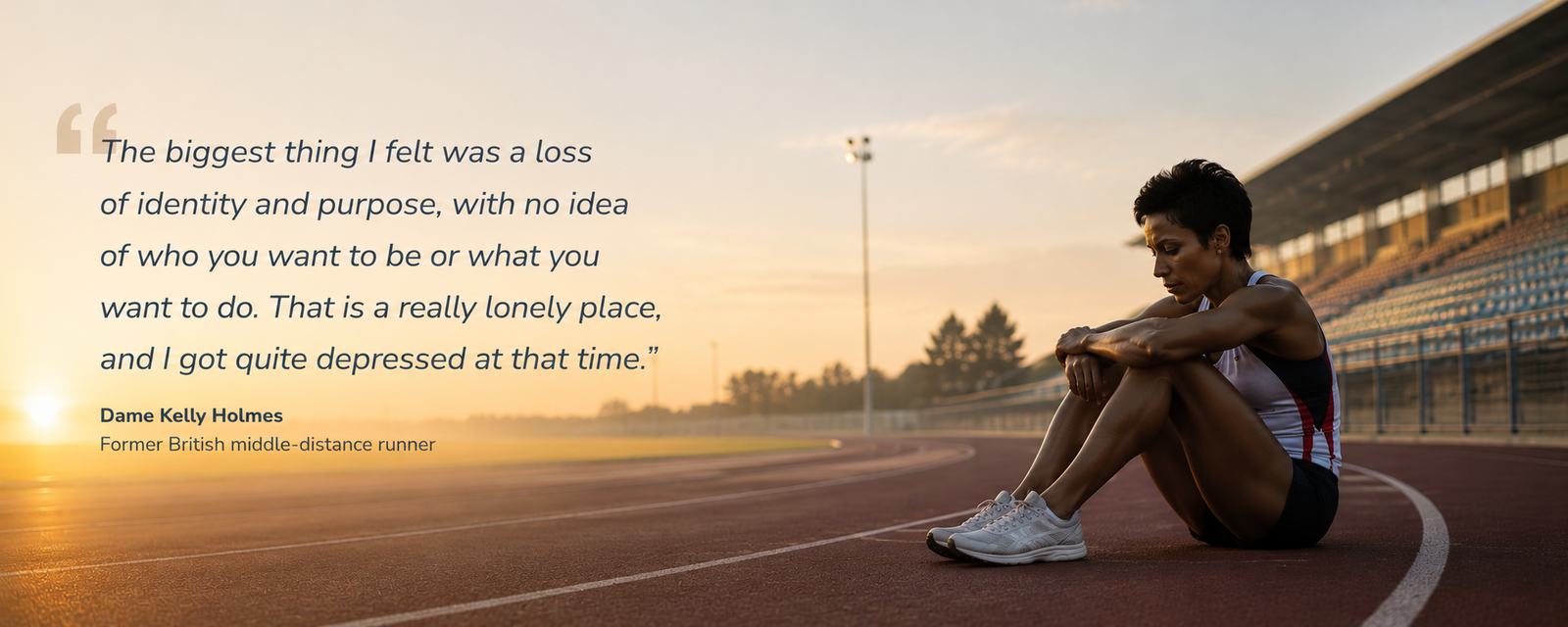
What Holmes describes is far from rare. Almost four in ten athletes struggle psychologically with the transition, nearly double the rate seen in ordinary retirement, and around a quarter of former elite athletes face anxiety or depression. At the heart of it lies a question that suddenly weighs heavily: who am I, now that I am no longer an elite athlete? When sport has been the centre of life for years, losing it leaves a gap. And that gap rarely comes alone, because the teammates, coaches and daily environment that were bound up with the sport often disappear at the same time.
At Leading Insights, we study how this transition can go better. Together with colleagues at the University of Queensland and the Australian National University, we map the role that social identity and group memberships play in protecting athletes’ health and wellbeing, both during and after their careers. Building on those insights, we developed More Than Sport, a programme that helps athletes shape their identity and social network as they leave elite sport. That work is now culminating in a large-scale randomised study that puts the programme’s effectiveness to the test.
In this section we build up our line of research step by step. We first show what our studies reveal about identity, groups and wellbeing after elite sport. We then introduce the More Than Sport programme, explain the results of our pilot studies, and finally offer a view of the ongoing large-scale study and how you can take part in it.
This research is an initiative of Leading Insights, in collaboration with the University of Queensland and the Australian National University, and is funded by the FWO project awarded to Prof. Katrien Fransen.
The first three articles based on these findings have already been published. The remaining articles are currently in preparation or under peer review, and we will update this section once they have been accepted for publication.
- Haslam, C., Lam, B. C. P., Yang, J., Steffens, N. K., Haslam, S. A., Cruwys, T., Boen, F., Mertens, N., Brandt, K. D., Wang, X., & Fransen, K. (2021). When the final whistle blows: Social identity pathways support mental health and life satisfaction after retirement from competitive sport. Psychology of Sport and Exercise, 57, 102049. https://doi.org/10.1016/j.psychsport.2021.102049
- Haslam, C., McAulay, C., Cooper, D., Mertens, N., Coffee, P., Hartley, C., Young, T., La Rue, C. J., Haslam, S. A., Steffens, N. K., Cruwys, T., Bentley, S. V., Mallett, C. J., McGregor, M., Williams, D., & Fransen, K. (2024). “I’m more than my sport”: Exploring the dynamic processes of identity change in athletic retirement. Psychology of Sport and Exercise, 102640. https://doi.org/10.1016/j.psychsport.2024.102640
- Young, T., Haslam, C., Coffee, P., Cooper, D., McAulay, C., Hartley, C., Mertens, N., Luong, M., La Rue, C., Haslam, S. A., Steffens, N. K., Cruwys, T., Bentley, S., Mallett, C. J., McGregor, M., Williams, D., & Fransen, K. (2024). More than sport: A social-identity intervention to support transitions out of elite sport. Psychology of Sport and Exercise, 75, 102697. https://doi.org/10.1016/j.psychsport.2024.102697