
Why does leaving elite sport weigh more heavily on one athlete than on another, and what helps people come through it stronger? That question is at the heart of our research. A strong athletic identity, the sense that “I am an athlete” sits at the core of who you are, is an asset during a career: it feeds motivation, perseverance and performance. The flip side only shows itself at retirement, precisely because that identity was so central. Here the following question often arises: who am I without my sport? We set out to understand exactly how this works, and what role the groups in someone’s life play in it.
Who we surveyed, and what we measured
For our first large study, we analysed responses from 215 retired elite athletes (Haslam et al., 2021). The group was largely European: around 63 per cent came from Belgium, alongside athletes from the Netherlands, Italy, Spain, Australia and Germany. Just under six in ten were women, the average age was about 29 (ranging from 16 to 48), and most had competed at international level. They had been retired for around three years on average, after a sporting career of roughly sixteen years. These were athletes recognised by their federation as (semi-)elite, across a wide range of sports.
Using questionnaires, we mapped four things: the extent to which athletes experienced a loss of their athletic identity; which groups they had in their lives (and whether they kept them or built new ones); two psychological resources, namely the sense that their life had meaning and the sense of being in control; and finally their wellbeing, measured through life satisfaction, depressive symptoms and perceived health. We also asked how their retirement had unfolded: was it their own choice, had they prepared for it, and did they receive any guidance?
To check whether our findings hold beyond Europe, we repeated the study with a second group of 183 retired elite athletes from China (on average almost 30 years old, about half women, retired for around seven years). This let us test whether the same patterns appear in a very different cultural context.
What the athletes reported
The picture was telling. More than three quarters of the athletes, around 77%, reported a loss of their athletic identity. That loss was directly linked to their mental health: the greater the identity loss, the more depressive symptoms.
The way athletes left their sport is also a cause for concern. Eight in ten said retiring was their own decision, but two in ten felt forced or under pressure to stop. And although this is a major life transition, preparation was often minimal. Only four in ten athletes had meaningfully planned the move in any way, and just one in ten received advice or support beforehand. Among the Chinese athletes voluntariness was even a lower: barely three in ten stopped entirely of their own accord.
What protects wellbeing
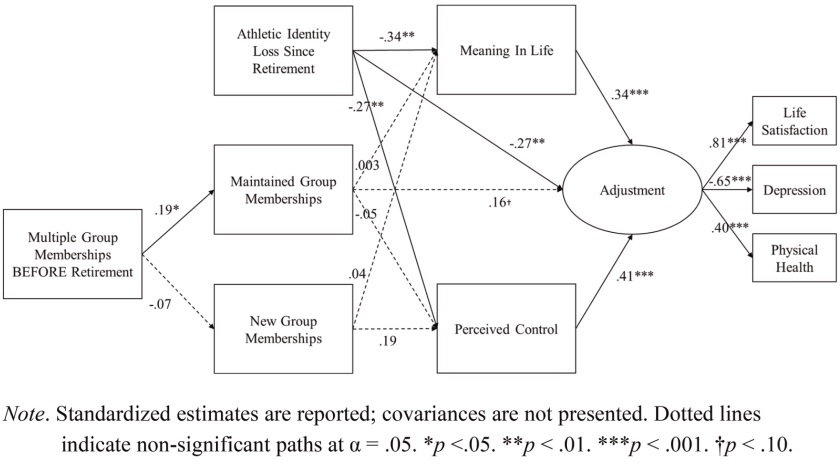
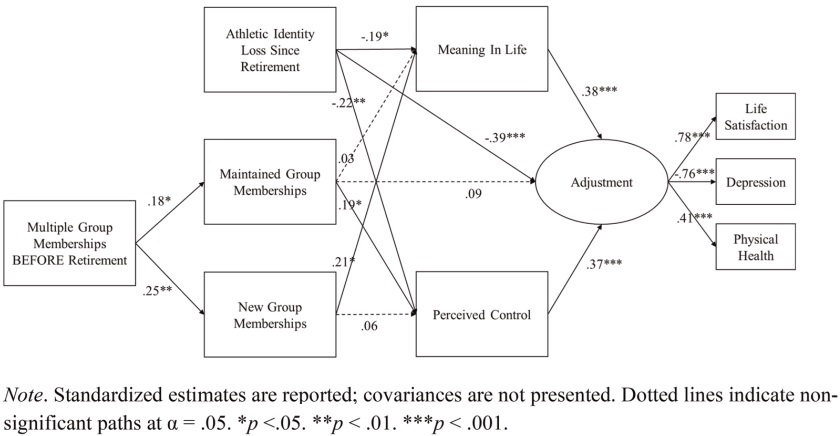
However, the central message of this study is one of hope. Losing the athletic identity undermines wellbeing mainly because it erodes two psychological resources: the sense that life has meaning, and the sense of being in control. Yet this is exactly where groups provide a counterweight. Both maintaining existing groups and building new ones buffered the negative effects of identity loss. Athletes who kept up or expanded their social connections reported greater life satisfaction, fewer depressive symptoms and better perceived health.
The broad lines recurred in both cultures, which suggests we are dealing with a broadly human mechanism. The finer interplay, in which maintained groups mainly feed the sense of control and new groups mainly provide meaning, came through most clearly among the Chinese athletes.
The model: the Social Identity Model of Identity Change
All of these findings come together in a single theoretical framework: the Social Identity Model of Identity Change (SIMIC). It explains how a major life transition affects wellbeing through the groups a person belongs to. Leaving elite sport means losing not just an identity, but often the groups attached to it, and that is exactly what puts wellbeing under pressure (the red arrow in the figure). Those who instead hold several group memberships, keep the ones they value and build new ones, sustain their wellbeing through the transition (the green paths). It is precisely these paths that the More Than Sport programme works on.
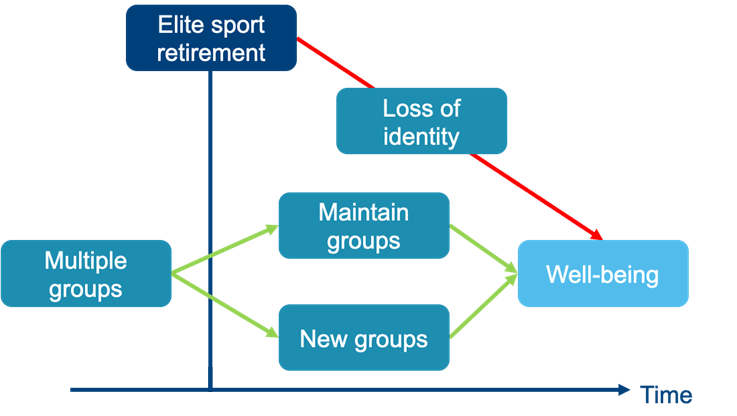
These figures show exactly how this works in both Western and Chinese former elite athletes. These are also precisely the pathways targeted by the More Than Sport programme.
Model in WESTERN context:
Model in Chinese context:
How athletes reinvent their identity
Numbers do not tell the whole story. In an in-depth study, we spoke at length with 21 successful retired elite athletes about how they reshaped their identity (Haslam et al., 2024). Each participant first completed a short online programme about leaving sport, and was then interviewed in depth. The conversations were analysed using reflexive thematic analysis, a method that looks for the recurring, meaningful patterns in what people say.
Three themes emerged:
- First, identity coloured not only the retirement, but also performance during the career.
- Second, the way athletes coped with identity loss differed sharply: those who saw themselves as “more than their sport” and held other roles adjusted more smoothly than those who had been wholly absorbed in sport.
- And third, the conversations revealed how athletes re-anchor their identity: some actively searched for a new one, while others gave existing roles a new meaning. This process lies at the core of the Social Identity Model of Identity Change, the model that forms the foundation of the More Than Sport programme.
References:
- Haslam, C., Lam, B. C. P., Yang, J., Steffens, N. K., Haslam, S. A., Cruwys, T., Boen, F., Mertens, N., De Brandt, K., Wang, X., & Fransen, K. (2021). When the final whistle blows: Social identity pathways support mental health and life satisfaction after retirement from competitive sport. Psychology of Sport and Exercise, 57, 102049. doi.org/10.1016/j.psychsport.2021.102049
- Haslam, C., McAulay, C., Cooper, D., Mertens, N., Coffee, P., Hartley, C., Young, T., La Rue, C. J., Haslam, S. A., Steffens, N. K., Cruwys, T., Bentley, S. V., Mallett, C. J., McGregor, M., Williams, D., & Fransen, K. (2024). “I’m more than my sport”: Exploring the dynamic processes of identity change in athletic retirement. Psychology of Sport and Exercise, 73, 102640. doi.org/10.1016/j.psychsport.2024.102640